
grpennycook@gmail.com / gordon.pennycook@cornell.edu
Google Scholar / CV / List of misinformation-related papers / List of human-AI dialogue papers
Faculty Profile / BlueSky / OSF
Background and Education
I am the Dorothy and Ariz Mehta Faculty Leadership Fellow and Associate Professor of Psychology at Cornell University. I am also an Adjunct Professor at University of Regina’s Hill/Levene Schools of Business.
I am an associate editor for Psychonomic Bulletin & Review, a member of the editorial boards for Thinking & Reasoning and the Canadian Journal of Experimental Psychology, and I am a consulting editor for Judgment and Decision Making. I was elected to be a member of the Royal Society of Canada’s College of New Scholars, Artists, and Scientists in 2020. I’m fortunate enough to have received early career awards for the Association for Psychological Science (“Rising Star”), the Canadian Society for Brain, Behaviour, & Cognitive Science, the International Social Cognition Network, and the Psychonomics Society. In 2016, I (with my co-authors) received the Ig Nobel Peace Prize for our work on the psychology of bullshit. Our bit in the (highly amusing) ceremony can be found here.
I completed my Bachelor of Arts (Hons) degree in 2009 under the supervision of Dr. Valerie Thompson at the University of Saskatchewan (Canada). In 2010, I moved to the University of Waterloo (also Canada) to work with Dr. Jonathan Fugelsang and Dr. Derek Koehler, receiving a Master of Arts degree in 2011 and a PhD in 2016. I then completed a two-year Banting Postdoctoral Fellow at Yale University (Department of Psychology) with Dr. David Rand and taught at the Yale School of Management with Dr. Shane Frederick. I was an Assistant and then Associate Professor at the University of Regina from 2018-2023. I then moved to Cornell and took an Associate Professor position.
I grew up in Carrot River, a lovely but remote* town of ~1,200 in Saskatchewan, Canada. [*Closest Walmart is ~2 hours away]
Research Interests
My research focus is on understanding the nature of human reasoning and decision-making. A lot of our problems as a species come from errors that we make during reasoning and decision-making – from global warming to health issues (including, but not limited to, the spread of pandemics) to political polarization and misinformation – and, thus, understanding why people make these errors is a major focus of mine.
My general view is that many of the most consequential errors that we make are due more to a lack of reasoning (and an overreliance on intuition) than too much motivated reasoning (e.g., due to political identity). A review of my theoretical perspective can be found here.
More broadly, I investigate the distinction between intuitive processes (“gut feelings”) and more deliberative (“analytic”) reasoning processes and am principally interested in the causes (a) and consequences (b) of analytic thinking. That is, what makes us think and why is it (thinking) important? This is critical to understand if we’re ever to find better ways to make decisions.
I have fairly broad interests, although most are organized under these two broad research programs (causes versus consequences). I’ve published on religious belief, sleep paralysis, morality, creativity, smartphone use, health beliefs (e.g., homeopathy), climate change rejection, pseudo-profound bullshit, delusional ideation, fake news (and misinformation more broadly), political ideology, science beliefs, and conspiracy beliefs (in roughly that order). I am also interested in the methodological and theoretical issues that pertain to the measurement of cognitive reflection and motivated reasoning. My research sits at the intersection of cognitive and social psychology and most recently I have gotten interested in the use of social media data for social science (both correlational and experimental). We have been testing various interventions against misinformation on social media, including accuracy prompts, fact-checking/debunking, crowdsourcing, labeling/warnings, and psychological “inoculation“.
For an overview of recent work on misinformation and motivated reasoning, click here. See published work for a full list of publications and working papers.
For a synthesis of behavioural science research on fake news (with a social and cognitive psych focus), see here. Below is a short explanation of some of our fake news research:
Another theme in my work is that I really enjoy developing new or improved ways of measuring important psychological phenomenon. For example, see here for a guide on one approach to developing materials to run studies on fake news and misinformation. I have also created a scale for assessing receptivity to pseudo-profound bullshit:
Another example that I’m excited about is a new way to assess dispositional overconfidence that does not fall prey to performance-related confounds (in short, if you’re bad at a particular task, you will appear uniquely overconfident… but, in reality, you’re just bad at the task). For this, people are given hard to discern “adversarial images”. For example, is there a chimpanzee or a baseball player in the following image?

Critically, people do not know if they get the answer correct (the correct answer is chimpanzee). That is, no one is good at this task. Nonetheless, when we ask people to estimate how well they have done on the task, some indicate higher levels of confidence. Since no one has any real basis for confidence in the task, this (we argue) provides a reliable measure of one’s tendency to be overconfident. Check out this paper (and this one) for the evidence and this paper showing that conspiracy believers are particularly overconfident.
Note for Potential Students
I am not looking for a graduate student in the upcoming year (2026). If you’re curious about our grad program at Cornell, please visit https://psychology.cornell.edu/graduate-admissions-requirements for more information.
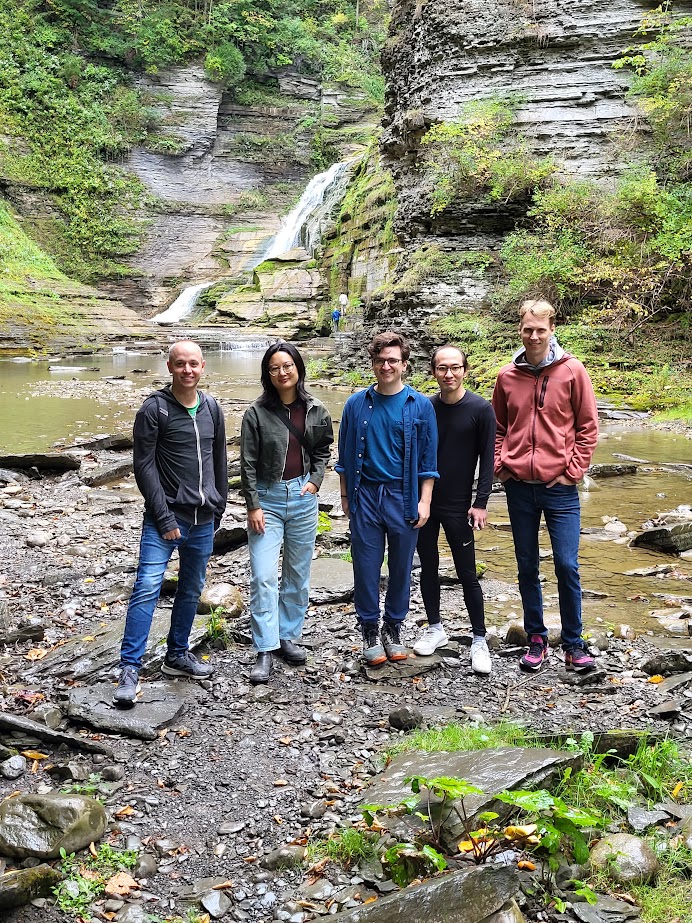
 Gordon Pennycook
One thought on “About”
Comments are closed.